
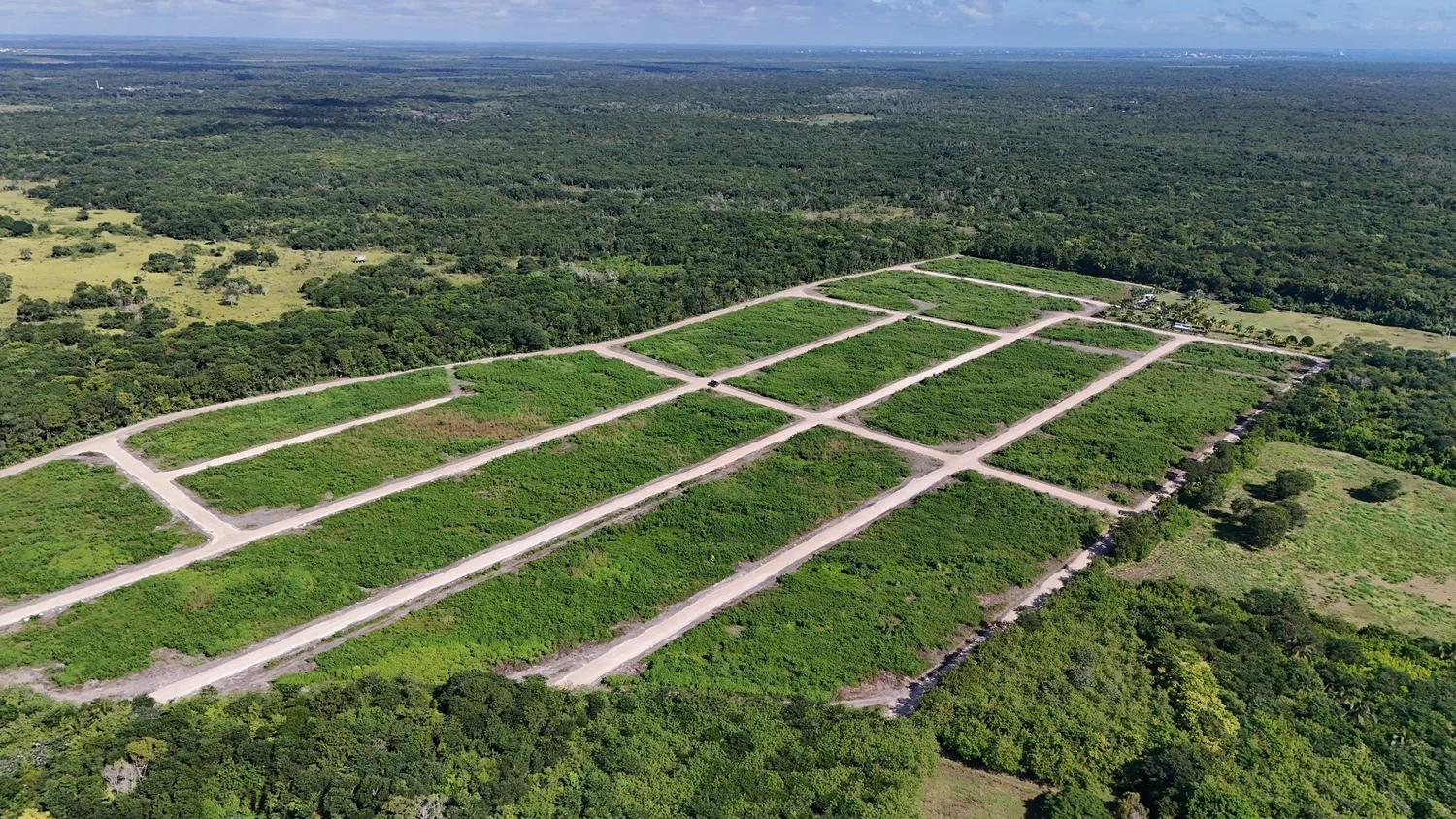
Lot elevation is how high your ground sits above the surrounding land, the road and the nearest water. In Belize, where much of the coast is flat and the rainy season is heavy, it largely decides whether your yard drains, whether your septic system works and how much you will spend on fill before you build. Check it before you buy, not after.
This guide covers how to read a lot's elevation, when fill makes sense, how to place it properly, what it costs to plan for, and the mistakes that cause cracked slabs and flooded yards. It applies to any lot in northern Belize, including ours.
Why elevation matters so much in Belize
The World Bank's climate risk profile for Belize notes that the country's low-lying terrain makes flooding and sea level rise worse. On a single lot, that shows up in practical ways:
- Drainage. Water runs to the lowest point. If that is your building pad, you have a problem every rainy season.
- Septic performance. A drain field needs unsaturated soil above the water table to treat wastewater. Low, wet ground can make a conventional system fail.
- Foundations. Wet or soft soil under a slab can settle unevenly.
- Access. A house on a high pad still needs a driveway and road that stay passable.
- Long-term risk. Global seas are rising (about 20 cm since 1901 per the IPCC figures summarized on Wikipedia), so a little extra height buys margin for decades ahead. See our post on sea level rise and coastal land.
How to read a lot's elevation before you buy
You do not need to be an engineer to spot warning signs, but you do need data for the final decision.
- Ask for survey and level information. A boundary survey shows corners and lines; a topographic or level survey shows ground heights. Ask the seller what exists, and if nothing does, budget for a surveyor to take spot levels. Our land survey guide explains the difference.
- Compare to the road. If the lot sits below the crown of the road, runoff from the road will head your way.
- Look at neighbors. Are nearby houses built up on fill or stilts? How high? Long-time residents usually build to what experience has taught them.
- Visit wet. Walk the lot during or just after the rainy season. Puddles that linger for days, spongy ground and water-loving plants tell you more than a dry-season photo.
- Find the water table. A hand-dug test hole or a percolation test (often needed for septic design) shows how close groundwater is to the surface.
What is fill, and when do you need it?
Fill is imported material (crushed rock, marl, sand or engineered soil) used to raise a building pad, driveway or yard. Many northern Belize builders raise at least the house pad, and sometimes the whole lot, above natural grade.
| Situation | Typical approach |
|---|---|
| Ground clearly above road and neighbors, drains well | Little or no fill; raise the slab modestly and grade away from the house |
| Ground roughly level with road, drains slowly | Fill the building pad and driveway; shape swales to carry water off the lot |
| Low, seasonally wet ground | Significant fill, or a raised foundation (piers, stilts or an elevated slab); engineer's input essential |
| Wetland or mangrove | Generally requires permits, may not be allowed, and is rarely a good choice for a first home |
Fill is not the only answer. A raised floor on concrete piers or columns lets water pass beneath the house and avoids importing large volumes of material. The right choice depends on soil, budget and design, which is why the decision belongs with a licensed engineer or architect.
Material quality matters as much as quantity. Ask your supplier what the fill is and where it comes from, and reject loads with roots, vegetation, trash or broken construction debris mixed in. Heavy clays can swell when wet and shrink when dry, which is not what you want under a slab. Your engineer can tell you which local materials suit a building pad and which are better kept for the yard.
How to place fill so it does not settle
The most common mistake is dumping a pile of material, leveling it and pouring a slab. Loose fill compresses over time, and the house cracks. Standard engineering practice, as described in the soil compaction literature, is:
- Strip the topsoil first. Organic soil and vegetation left under fill will rot and compress for years.
- Place fill in layers ("lifts") rather than all at once, compacting each lift before adding the next.
- Control moisture. Fill compacts best near its optimum moisture content; bone-dry or saturated material will not reach full density.
- Test where it matters. For a building pad, an engineer can specify a target density (often referenced to a Proctor test) and check it.
- Let it settle when possible. Many builders let a new pad sit through some rain before pouring the slab.
- Extend the pad beyond the walls so the edges of the slab are not sitting on a crumbling slope.
Drainage: the other half of the job
Raising your lot without thinking about where water goes can simply push the problem onto a neighbor, or back onto you. A good plan:
- Grade the ground to slope away from the house on all sides.
- Direct roof runoff to a cistern or a soak-away rather than the foundation (see rainwater cisterns in Belize).
- Keep natural drainage paths and road ditches open; don't block culverts.
- Respect your HOA covenants on grading, fill and drainage between lots, if your subdivision has them.
Permits, rules and costs to plan for
House plans in Belize go through the Central Building Authority (CBA) or a certified municipal building unit, and plans include a site plan and foundation details. The CBA's construction process requires approved drawings on site for the setting-out inspection, so your elevations and pad layout should be finalized before work starts. Our post on building permits in Belize covers the full process.
Larger earthworks, work near the coast and anything involving wetlands or mangroves may need clearance from the Department of the Environment and, for mangroves, the Forest Department. Confirm with those agencies and a licensed Belizean professional before you move material.
Costs vary with how far the material travels, the type of fill and the volume. Rather than rely on a rule of thumb, get quotes based on the volume your engineer calculates (area times average depth). A simple worked example: raising a 50 ft by 40 ft house pad by 2 ft takes about 4,000 cubic feet, or roughly 148 cubic yards, of compacted fill, and you will need more loose material than that because fill shrinks as it is compacted. Ask suppliers how they measure a load and whether delivery and spreading are included.
Frequently asked questions
How high should I build my floor in northern Belize?
There is no single legal number for every site. A licensed engineer should set the finished floor height using level data, neighbors' experience and flood history.
Can I build on a lot that floods occasionally?
Often yes, with fill or a raised foundation and good drainage, but it costs more. Know the cost before you buy.
Is fill or stilts better?
Each has trade-offs. Fill gives a solid pad and usable yard; raised foundations need less material and let water pass. Your engineer can compare both for your soil and budget.
Does Coastal Vista fill lots?
Coastal Vista sells land only. Roads are cut and lots are laid out; site preparation for your home is part of your build, handled with your own builder.
Walk the ground before you choose
Elevation is easiest to judge in person, ideally after a good rain. Shortlist lots on the Coastal Vista lot map, then book a visit and bring your questions about drainage and site preparation. Our design and build page outlines how buyers work with local professionals once they own land.